I break a lot of traditional rules in therapy session.
I am unconventional therapist
4/4/20262 min read

My clinical training in Canada taught the Person-Centered approach as the gold standard acting as a mirror of unconditional positive regard so clients find their own way.
The humbling truth? Accurately catching and validating another human's exact feeling state is extremely difficult and it is truly masterful art. I am still practicing and refining it every single day.
Traditionally, the fear is that guiding too much interferes with a client's autonomy, and for a long time, I wrestled with my own directness.
Am I crossing a line? Because the truth is, I don't just sit back and nod in my session.
When a client is stuck in an intellectual spiral, chest tight and breathing shallow, I don't just ask, "How does that make you feel?" I interrupt. I may ask them to close their eyes and do a visualization to bypass their logical defenses.
If we are dodging a hard truth, I don't wait weeks for a natural stumble. I use radical transparency and blunt humor to call out the elephant in the room.
Honestly, I struggle with the "validation loop": spending months nodding and saying, "That sounds hard," without actually helping someone move forward.
While some might find my approach controversial, I found a missing puzzle piece in my Asian roots.
True harmony in Asian philosophy is highly active; a profound, unspoken bond of care and mutual responsibility.
Restoring balance requires an active guide. If you are stepping near the edge of a cliff, me acting from a place of deep harmony won’t wait till you realize the cliff, I will grab your hand and pull you back first and explore the cliff you were " drawn to".
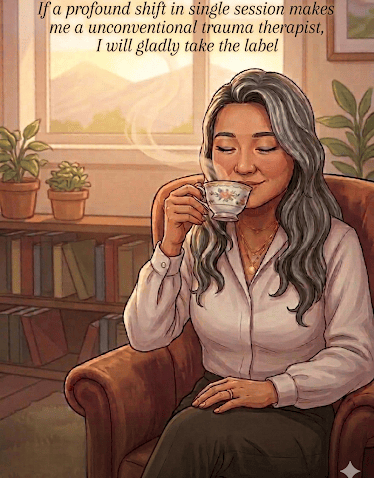
I’ve made my peace with being an Unconventional Trauma Therapist. I will always strive for that deeply accurate person-centered empathy, because when you get it right, it is healing magic.
I also give myself permission to embrace an active, guiding harmony.
If breaking the "blank slate" rule, using humor, and calling out blind spots helps someone heal in five sessions instead of fifty, I will gladly take that trade.
Therapy shouldn't just be about feeling heard; it must be about experiencing real, tangible change. I'm not just here to listen anymore. I'm here to take the risks with you.