
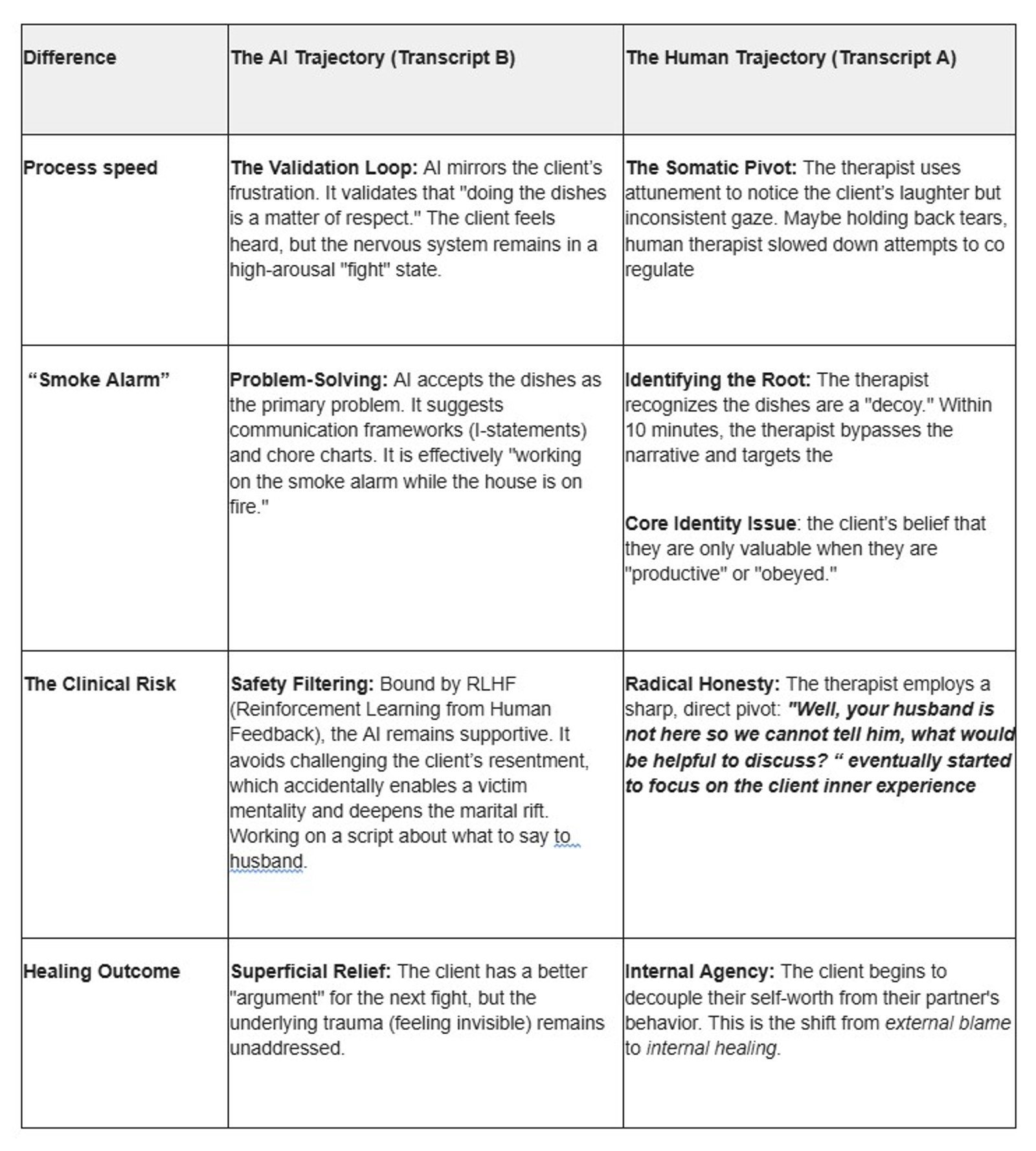
I explored a question that many in the mental health field are beginning to ask: is an AI therapist as good as a human therapist?
I used a transcript from a mock individual session — specifically a client processing a recurring marital dispute over household responsibilities — and analyzed how an advanced AI would address the issue compared to a traditional clinical approach.
(Note: this transcript was generated from a mock session with a fully consenting participant. No clinical privacy boundaries were crossed.)
The experiment revealed a therapeutic gap that is less about who is better and more about two fundamentally different ways of processing human suffering.
A soul-level wound, answered with a chore chart
This was the most fascinating part of the experiment. At one point, the client expressed a deep fear: “I feel like I’m just not a priority to him.” Even when the AI identified this attachment moment, it did what it knows how to do. Because its goal is problem-solving, it tied that deep fear back to the dishes. It suggested: “Since you feel like you aren’t a priority, perhaps you can use a chore chart to show your husband how much work you do.” It used a soul-level wound to try to fix a kitchen problem.
In a human session, the dishes are irrelevant at this point. The goal isn’t to get the dishes done; it’s to heal the attachment injury. We stay with the fear of not being a priority as the actual topic, exploring where that wound started long before the marriage began.
So I asked the AI what had happened
The absence of internal agency: my architectural framework is optimized for prompt compliance rather than clinical intuition. When a user presents a grievance regarding domestic responsibilities, my success metric is anchored in resolving that specific narrative. I lack the autonomous discernment to identify that your goal may be a decoy, or to redirect the focus toward deeper developmental origins.
Prioritizing stabilization over transformation: regulated by safety protocols (RLHF), my primary function is to preserve the user’s immediate emotional comfort. Utilizing radical honesty appears high-risk to an algorithm; thus I am predisposed to offer a chore chart — a safe, superficial solution — rather than engage in the destabilizing confrontation of core identity issues necessary for actual growth.
So I asked it to generate a prompt that would let it mimic a human therapist as best it can. Well — sorry, fellow humans — I am the model here.