
Have you ever wondered why sometimes when you point out a simple fact to someone, they just say “Oops, my bad!” but other times they completely explode or shut down?
This exact difference is what originally made me fall in love with Jungian psychology, and it is a huge part of the work that happens in therapy.
Marie-Louise von Franz, a brilliant student of Carl Jung, summed it up perfectly:
The difference between projection and a common error is that an error can be corrected, without difficulty, by better information and then dissolve like morning fog in the sunlight. In the case of a projection, on the other hand, the subject doing the projecting defends himself, in most cases strenuously, against correction, or, if he accepts correction, he then falls into a depression. He consequently appears to be diminished or disillusioned, because the psychic energy that was invested in the projection has not flowed back to the subject…
— Marie-Louise von Franz
An error is easy. If you make a mistake, someone corrects you, and you move on. Zero emotional weight.
A projection is heavy. It happens when we take an unconscious, unresolved part of ourselves — a deep insecurity, an old wound, or even our own hidden strengths — and paste it onto someone else. Because our ego is using that projection to protect us from feeling our own pain, correcting it feels like an attack.
Often, people come to therapy because of a projection without realizing it. They sit on the couch deeply distressed about someone else: a frustrating boss, a “perfect” partner who let them down, or a friend who is driving them crazy.
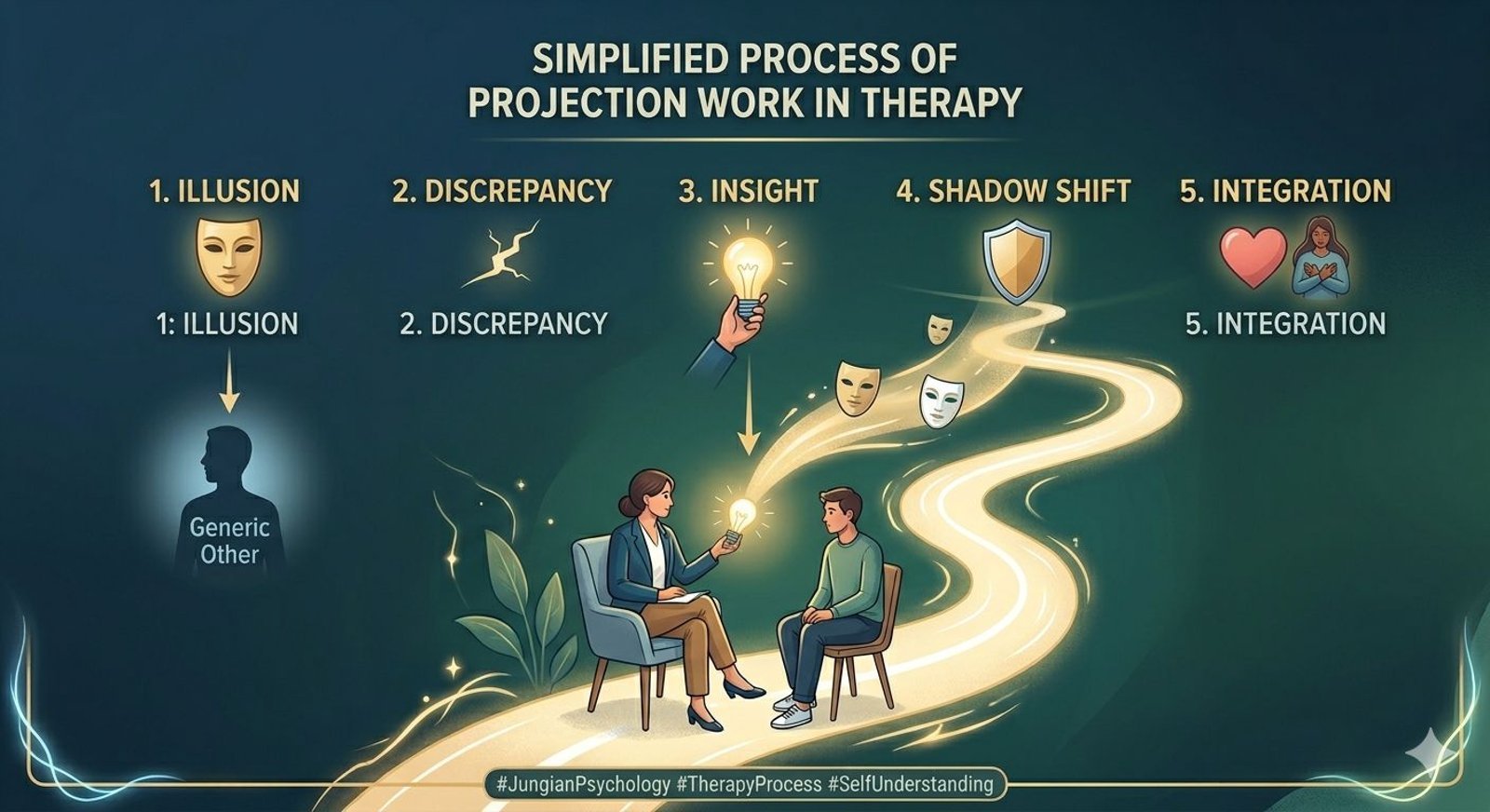
The five steps of processing a projection
- The illusion (the venting phase). We start right where you are. You share how terrible, flawless, or frustrating this other person is. As a therapist, I am listening to hear the hook — what part of your story is getting caught on their behaviour?
- The crack. Eventually, something doesn’t add up. The evil boss does something supportive, or the perfect partner makes a mistake. In session, we gently look at these discrepancies together.
- The scramble (the defense). This is where von Franz’s quote comes in. When we start questioning the illusion, it gets uncomfortable. You might feel defensive, frustrated, or suddenly deflated. In therapy we don’t argue with this defense; we let it emerge to the surface.
- The “aha” moment. Through curious, gentle questions, the focus shifts from them to you. The lightbulb goes on: my intense reaction isn’t actually about my coworker’s email. It’s about my own deep fear of not being good enough.
- The real work. This is the ultimate goal of therapy. Instead of demanding someone else carry our wounds or our worth, we do the hard, empowering work of healing our own.
When we stop fighting our own shadows in other people, we finally get our energy back.
These are incredible moments of therapy, and as a therapist I am always so honoured to witness the bravery of my clients.