
Books
Words that outlast the session
Jae in print: the books, where to read them, and what early readers said.
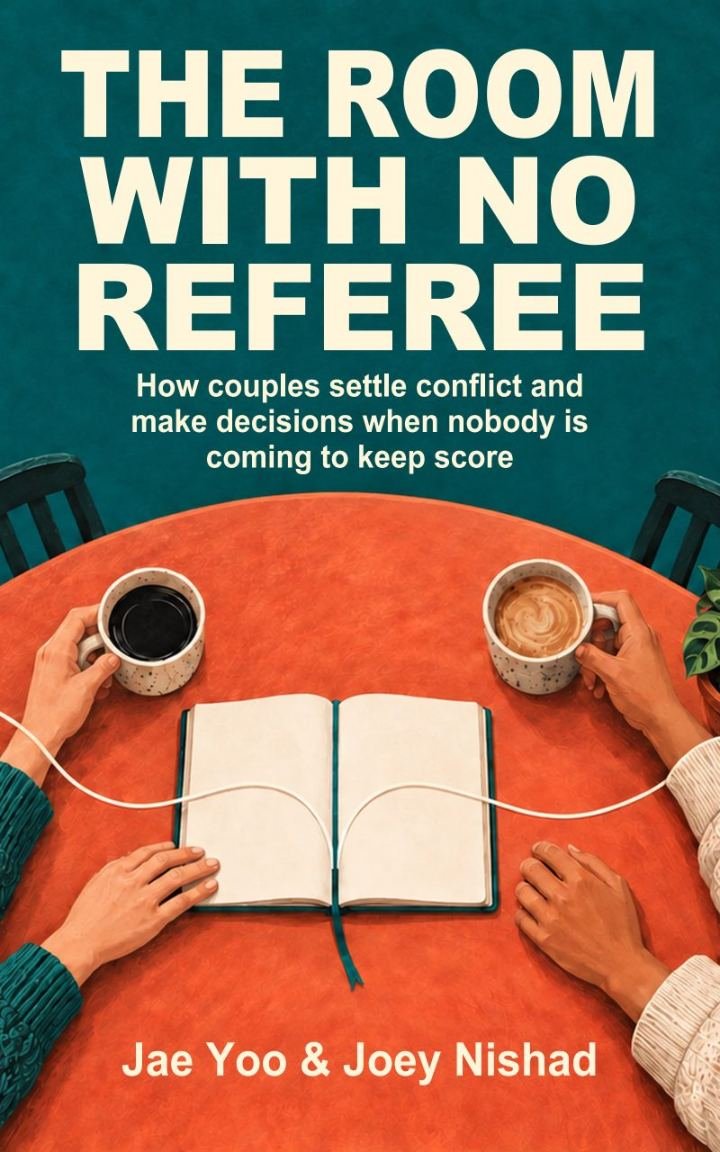
The Room with No Referee
How Couples Settle Conflict and Make Decisions When Nobody is Coming to Keep Score
Jae Yoo, M.Ed., CCC-CCS · Joey Nishad
Relationships are wonderful, but they are not easy. They can be hard. Couples have to figure out answers to some very hard questions, without losing anything that is precious to them. This is easier said than done. Every hard question can sometimes take the toll, which adds up, and comes up, over and over again, for many years down the road. But every system built to settle hard questions like this, usually has one person in it, with nothing riding on the answer. A referee, if you will. Couples don't have this option. Not really. People meddling in the relationship with their own agendas don't make a good referee. But we can build a robust system to guide couples through the hard questions life throws at them!
At twenty to midnight on a Saturday, Nell and Adrian are still at the kitchen table. There is a contract open on the laptop, a building report with one line highlighted, and an offer that closes on Monday. They have been patient for four hours. They have each argued the other's case at least once, which is supposed to be the mark of a good relationship, and it has not helped. Somewhere around the third pass the conversation quietly changed subject, from whether to buy the house to whether Adrian's feelings count as evidence, and from there to a particular Christmas in 2019. What is missing from that kitchen is not patience. It is not love, which was never in doubt and is part of the problem, because people who love each other are careful, and careful people talk in code.
What is missing is a person who does not care how it turns out. A boxing match has a referee, and the referee's most important act is stopping the fight, because that is the one decision neither fighter can make about himself. A court has a judge. A board has a chair who does not own the proposal. Each of those arrangements puts one person in the room who is not a vested party, because we worked out, two motivated parties cannot do that job for each other.
There is no external examiner for a marriage. At 11.52pm in a kitchen, the entire population of the room is two parties. This is not a defect but the shape. Still, every job that a referee would have done, has to be done.
The Room With No Referee takes the referee apart, job by job, and shows what two people can build in place of each one. Not seven habits. One procedure, with a beginning both people recognise, a rule that says when it is finished, and a record that outlasts anybody's memory of it. It can be learnt in a fortnight and it is still working in thirty years, because it does not depend on either person being calm, articulate, well slept or in a good mood, which are the four conditions never available at the moment you need them.
The eight jobs a neutral third party performs, translated into things two people can do to themselves: the order of business, the timing rule, the burden of proof, the sealed independent proposal, the ruling on what is actually being decided, the trial period, and the record. An honest verdict on the six substitutes people reach for instead, including the group chat, the friend who says the plan is bad, the grand gesture and the four-letter personality type, with the evidence for each stated at its real strength and no higher. A chapter for readers with nobody to run any of it with yet, whether widowed, divorced, or choosing more carefully this time. You are not choosing a person. You are choosing who you will have no referee with, and those are different questions with different evidence behind them.
Built on 49 peer-reviewed sources, every one verified and cited, including the longitudinal conflict research that most relationship books quote and few report accurately. Where the evidence is thin, this book says so on the page where it is used, rather than in a note at the back. Nobody is coming. Here is what to build instead.
Get the book